
Hip strength and mobility for skiing: what actually matters
In skiing, the hips don’t need to be “powerful” or “dynamic” in an abstract sense.
They need to move through enough range and control that range under load, repeatedly, often on one leg at a time.
When that’s missing, the body usually finds motion somewhere else, most often at the knees or the lower back. Over time, that can increase joint stress, especially during long ski days, variable snow, or high-volume training.
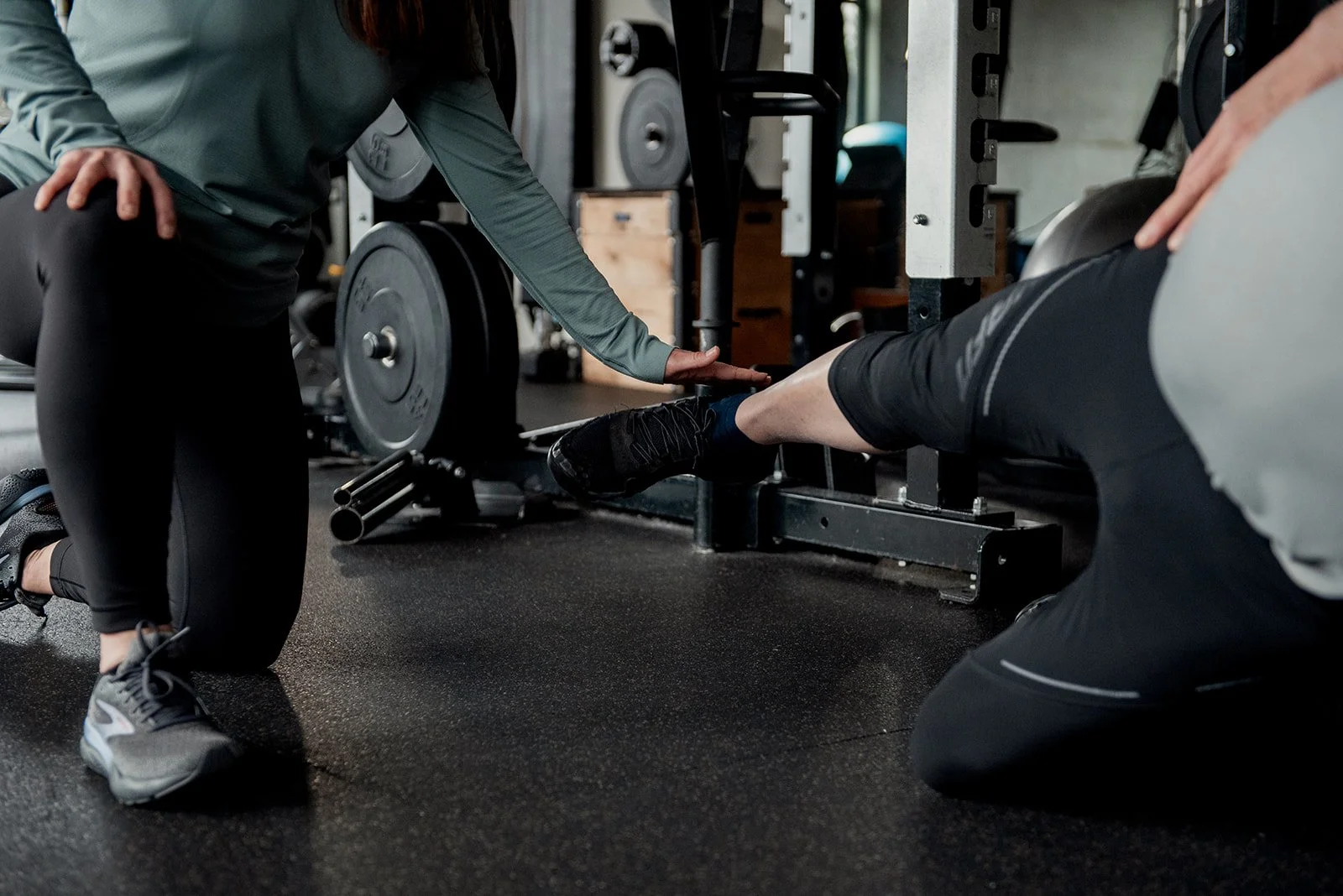
What the hips do during skiing (concretely)
During a turn, the hips are responsible for:
Allowing rotation of the femur inside the socket (internal/external rotation)
Controlling side-to-side movement (frontal plane control)
Helping maintain alignment between hip, knee, and ankle
Absorbing and redistributing load when pressure builds through the ski
You don’t need extreme mobility, but you do need enough range to stay centered and enough strength to control it, especially in asymmetric or single-leg positions.
Exercises that actually carry over to skiing
The following exercises are commonly used in sports rehab and performance settings because they address rotation, lateral strength, and single-leg control, all relevant for skiing. The goal isn’t max load. It’s quality of movement.
1. 90/90 Hip Rotations
What it works
Active internal and external hip rotation.
How to do it
Sit on the floor with both knees bent at 90°, one leg in front, one behind.
Sit tall — avoid rounding or leaning back.
Slowly rotate both knees to the other side without using your hands.
Pause briefly, then rotate back.
What to focus on
Smooth, controlled motion
Minimal movement through the spine
Stay within a range you can control
Why it matters for skiing
Hip rotation is part of turn initiation and direction changes. This exercise trains rotation without forcing it.
2. Cossack Squats
What it works
Lateral hip strength and mobility.
How to do it
Take a wide stance.
Shift your weight to one side, bending that knee.
Keep the other leg straight with the foot flat or toes up.
Push back to center and switch sides.
What to focus on
Chest stays upright
Heel stays down on the bent leg
Controlled depth — don’t force range
Why it matters
Skiing involves constant lateral weight shifts. This builds strength in positions similar to wide, offset stances on skis.
3. Goblet Squats
What it works
Hip and knee coordination under load.
How to do it
Hold a kettlebell or dumbbell close to your chest.
Sit down between your hips.
Keep knees tracking over toes.
Stand up with control.
What to focus on
Even pressure through both feet
No collapsing at the knees
Depth you can control
Why it matters
This reinforces a stable, balanced squat pattern that carries over to absorbing forces on skis.
4. Side-lying Hip Abduction
What it works
Gluteus medius (key lateral stabilizer).
How to do it
Lie on your side, bottom knee bent, top leg straight.
Lift the top leg slightly back and up.
Keep hips stacked; don’t roll backward.
Lower slowly.
What to focus on
Small, controlled range
No momentum
Tension stays in the side of the hip, not the lower back
Why it matters
This muscle helps control knee alignment during single-leg loading — relevant for injury prevention.
How to use these exercises
2–4 times per week
Low to moderate reps (6–10 controlled reps)
Prioritize quality over fatigue
Pair mobility work with strength work
These movements are most useful before they’re needed on snow, not once pain shows up.
Takeaway
Good hip function for skiing isn’t about chasing extremes. It’s about having enough range, enough strength, and enough control to handle repeated turns, uneven terrain, and long days without compensating elsewhere.
Train the hips to move well, and the rest of the system usually follows.
If you have questions, feel free to contact us.